


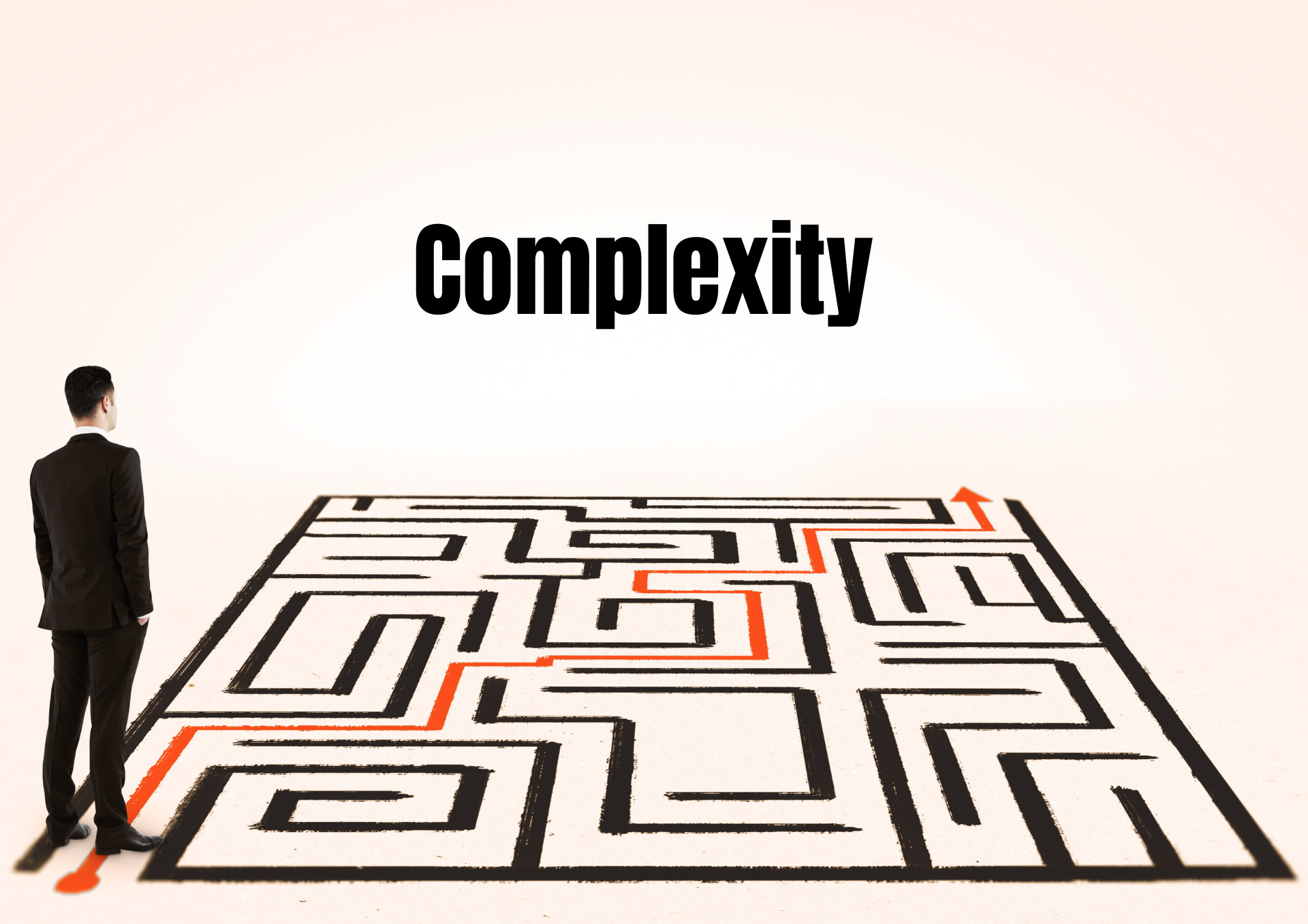
Complexity has become an everyday feature of our modern political and economic systems. It is a decision-making risk, a test of strategic clarity, and ultimately a source of increasing costs at all levels, from the world’s most powerful institutions and businesses to those that are much smaller.
It’s an all-too-common phenomenon today to find many voters struggling to make sense of the government’s latest policy reforms, or customers overwhelmed by too many product choices. Complexity in itself is not necessarily a bad thing or good thing, but from a political and business perspective, it has a cost, so we should ask how much of it is just too much.
Occam’s Razor offers us a useful rule of thumb. It is the idea that the simplest explanation or solution is often the best. But still, oversimplification is not a panacea either because if we strip away too much complexity, we could end up creating new types of dysfunction. So, the art seems to lie in managing the right degree of complexity, that is to say, enough of it to reflect reality and enable adaptability, but not so much that we lose the people we intended to serve.
Complexity and the Bottom Line
In business, complexity has a way of permeating most areas of the modern business operation. This is often clearly visible to the naked eye, where too many products and services, bloated organisational structures, and decision paralysis are all too common. That’s not to forget the increasing complexity also found on the outside, such as today’s unpredictable trading system.
There have been numerous studies from the consultancy industry, the field of management research, and empirical cases that have suggested that excessive complexity can often reduce productivity and business profitability through the fog of hidden costs driven by symptoms such as duplication of effort, slower decision cycles, and disengaged employees.
Prominent examples of where complexity has weighed too heavily on day-to-day operations have included the multinational conglomerate General Electric before its recent breakup. GE was a sprawling conglomerate with layers of bureaucracy that slowed innovation and blurred accountability. Its challenge wasn’t a lack of smart people but an excess of interdependencies facing an increasingly disruptive external environment that ultimately made it too big to succeed. When every decision requires cross-divisional alignment, agility becomes very difficult to achieve. A contrasting example was at Apple under Steve Jobs, who simplified its product line dramatically, focusing on fewer products with deeper integration, which brought speed, coherence, clarity, and a competitive advantage that drove growth in subsequent years.
The problem with complexity is that every additional variable or feedback loop can add further cost, not just in monetary terms, but often in less tangible areas such as information processing, coordination, and attention; costs that can escape a traditional accounts department. The scholar and Nobel laureate Herbert Simon called this the “bounded rationality” problem, where decision-makers can only process so much before outcomes degrade. Businesses that don’t respect these bounded limits often end up burning more time and resources on managing the system rather than innovating further within it.
Complexity in Politics
The same type of dynamic plays out in the world of politics. Modern governance is also challenged by complexity. It involves layers of regulations, interdependent ministries, and intricate policy trade-offs. Each is normally designed to solve pressing problems, such as wealth, inequality, or insecurity, but collectively they can create even more complexity that few voters can easily unscramble. The result is often public cynicism or populist backlash.
When voters perceive that their systems of government are too complex to understand, it is not entirely surprising that they will gravitate toward more simplistic narratives. In recent years, examples abound of populist leaders exploiting this by offering clear villains and quick fixes with slogans such as “close the borders” or “take back control”. These types of slogans thrive because they simplify a complex reality into emotionally legible a la carte choices.
But oversimplification also comes at a cost, because we still need to know how things work in order to make informed choices. Democratic legitimacy to a large extent depends on public comprehension of how systems distribute wealth and power. When complexity outpaces comprehension, democratic accountability is likely to erode. This is why reforms such as Sweden’s transparent fiscal framework, which ensures that citizens have insight into fiscal policy, are needed for restoring intelligibility and support.
Not Too Simple, Not Too Complex
Politics and business operate as adaptive systems, that is to say, they are networks of interdependent parts that must continuously adjust to feedback and change. Complexity is inherent to such systems. However, if we could eliminate complexity entirely, we would lose resilience. On the other hand, if we were to allow it to continue to grow unchecked, we would lose direction.
The sweet spot seems to be that point where systems maintain enough diversity and optionality to respond to shocks without becoming unmanageable.
In the political world, this means that we should be designing policies that reflect the real complexity of our economies (such as climate transitions or global taxation) while also communicating them clearly and accessibly. In the business world, it means offering consumers meaningful choices, but without overwhelming them. IKEA is a good example. Most people have shopped there at some point. They offer enough variety for customers to personalise their furniture, but still, not enough products to overwhelm them. Its legendary success hinges on managing immense internal complexity that remains largely invisible to the customer.
In both of these worlds, adaptive change is the name of the game. As the political scientist Charles Lindblom once said, policymaking is often the art of “muddling through”, that is to say, incremental adaptation rather than grand design. Businesses, too, thrive when they exercise caution and treat complexity as a dynamic variable to be balanced rather than eliminated.
Vanilla Isn’t Always a Good Strategy
While excessive complexity is costly, zero complexity can be equally disastrous if it strips away all distinctive value. In the political sphere, overly simple policies, such as blanket subsidies or tax cuts without corresponding fiscal balancing, often create long-term distortions to the economy. Meanwhile, in business, overly simplistic “vanilla” offerings that fail to solve a real problem or meet a market need can quickly lose relevance.
For many products and services, consumers now expect at least some level of choice, customisation, and depth in their experience. Netflix’s recommendation algorithm is a great example with how it manages immense complexity in its backend systems and data algorithms but delivers an experience that feels effortless and personal. Political systems can also work the same way. The European Union, for example, operates through layers of complex institutions and negotiations, yet strives to present simple, unified policies to its citizens and member states.
Managing how complexity is experienced is key. Well-designed systems tend to keep their external appearance clear and intuitive while handling the sophistication internally. It’s a bit like a duck paddling through a pond, all quiet on top, but a lot of activity underneath. The best product designs and public policies make participation easy, even when the machinery working underneath is anything but simple. The worst ones tend to do the opposite.
Making the Best of Complexity
So, to optimise complexity, managing it should be less about elimination and more about channeling it effectively. Here are five practical ideas drawn from political economy, systems thinking, and management strategy that can help master the challenge of complexity.
1. Apply Occam’s Razor, But With Context
Simplify only where it adds clarity, not where it removes meaning. If a layer, rule, or product variant does not serve a useful purpose, eliminate it. Unless, of course, it is something that holds the system together.
2. Use Systems Mapping Before Decision-Making
Visualising interconnections helps to expose where complexity adds resilience and where it just creates noise. This helps us to see which changes create unintended consequences.
3. Design for Comprehension, Not Just Control
In business, this means designing clear product architectures and decision frameworks that pass the “explain it to me on one page” test. If it doesn’t, more work is needed. In politics, it means translating policy into accessible stories and visual models that voters will understand.
4. Institutionalise Adaptive Learning
Complexity tends to evolve. So, it makes sense to build learning loops into our systems. The best systems evolve through feedback-informed adaptation rather than a top-down overhaul.
5. Balance Optionality and Coherence
Whether designing a product or a new regulatory framework, flexibility is needed, and that should be balanced with focus. There should be choice, but organised around a clear narrative or mission, so that there is also coherence.
Complexity and Power
In the realm of political economy, complexity itself has become a form of soft power. It’s a question of how it is harnessed. Nations that can manage complex systems such as financial markets or globally connected supply chains, project stability, and tend to attract more capital. Similarly, businesses that master complexity with nuance tend to become indispensable nodes in value networks.
It’s about aligning the moving parts without overdesigning the system. Amazon’s platform model, for example, thrives on structured complexity. It has millions of independent sellers who share the same infrastructure and follow clear rules. In governance, the European Union’s regulatory “soft power” works in a similar fashion, where it is able to export stability through the setting of standards in many areas, from chemicals to digital services.
Final Thoughts
Complexity poses a real challenge in both politics and business, but the answer should not be oversimplification. To succeed, our goal should be to make complexity more navigable.
Occam’s Razor gives us a good starting point: prefer the simplest explanation when all else is equal. But the right degree of complexity also has its place. Systems thinking completes the picture by recognising when complexity is essential for resilience, diversity, and adaptability. Between these two poles lies what is arguably the real leadership challenge of our data-intensive era: mastering the economics of understanding, because it matters how we spend and invest our attention.